Research
My research focuses on climate dynamics and variability across the atmosphere, ocean, and cryosphere. I use a combination of theory, numerical modeling, climate model analysis, and simple dynamical models to understand how ice sheets, sea ice, and large-scale modes such as ENSO and the QBO interact with eachother and the broader climate system.
A common thread in my work is the use of model hierarchies: pairing complex climate model output with idealized and conceptual models to isolate mechanisms, test hypotheses, and distinguish signal from noise in a highly variable climate system.
1. Paleoclimate Modeling: understanding glacial cycles
One line of my research examines the growth and retreat of icesheets (in particular the Laurentide Ice Sheet (LIS)) across the glacial cycles.
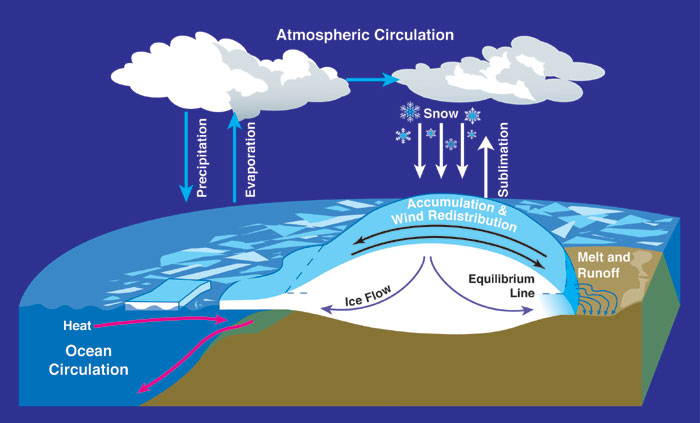
- Generally, I examine how the surface mass balance (SMB) of various ice sheets responds to changes in albedo, temperature, precipitation, and sea ice cover.
- I compute the SMB of the LIS using the isotope-enabled iTRACE simulation and compare it with mass-loss rates inferred from geophysical reconstructions (e.g., ICE-6G).
- Ongoing work investigates why the LIS grew near 80 ka but retreated rapidly near 12 ka, disentangling the relative roles of insolation, sea-ice extent, circulation changes, and feedbacks tied to albedo and meltwater.
Together, these projects aim to clarify the conditions under which ice-sheet evolution is primarily controlled by external forcing versus internal climate variability.
2. Pacific Teleconnections: ENSO–QBO interactions and large-scale variability
Another focus of my work is the interaction between ENSO (El Niño–Southern Oscillation) and the Quasi-Biennial Oscillation (QBO).
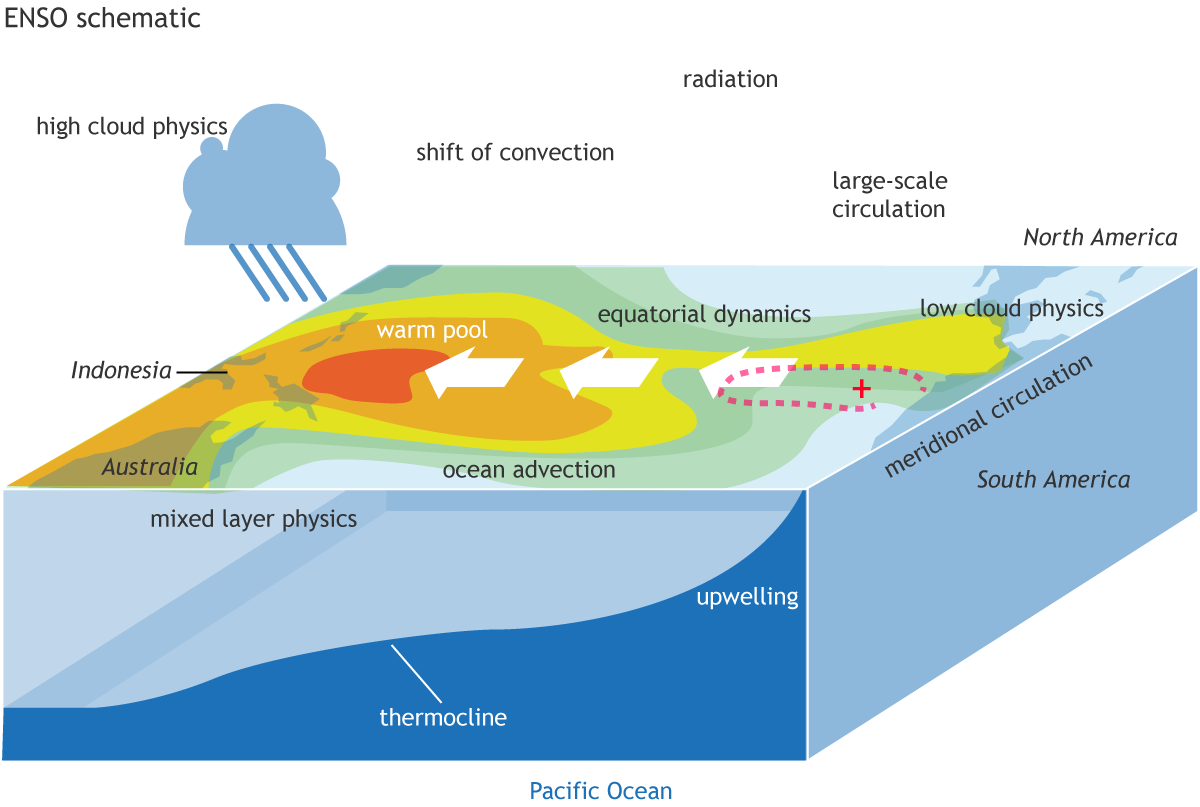
- Using reanalysis and CMIP6 preindustrial control runs, I evaluate whether the observed ENSO–QBO correlation is evidence of a robust dynamical coupling or can be explained by statistical coincidence in a short record.
- In companion work, I develop simple dynamical models to test candidate mechanisms, including QBO impacts on wave propagation, tropical upwelling, and ENSO amplitude and timing.
- Separately, I advise an undergraduate research student working on machine learning techniques to classifying westerly wind bursts.
This combination of data analysis and theory aims to determine when we can confidently claim a mechanistic teleconnection versus when apparent relationships are consistent with stochastic variability.
3. Sea Ice, Surface Mass Balance, and High-Latitude Feedbacks
I am also interested in how sea-ice variability interacts with ice-sheet and ice-sheet–adjacent climates.
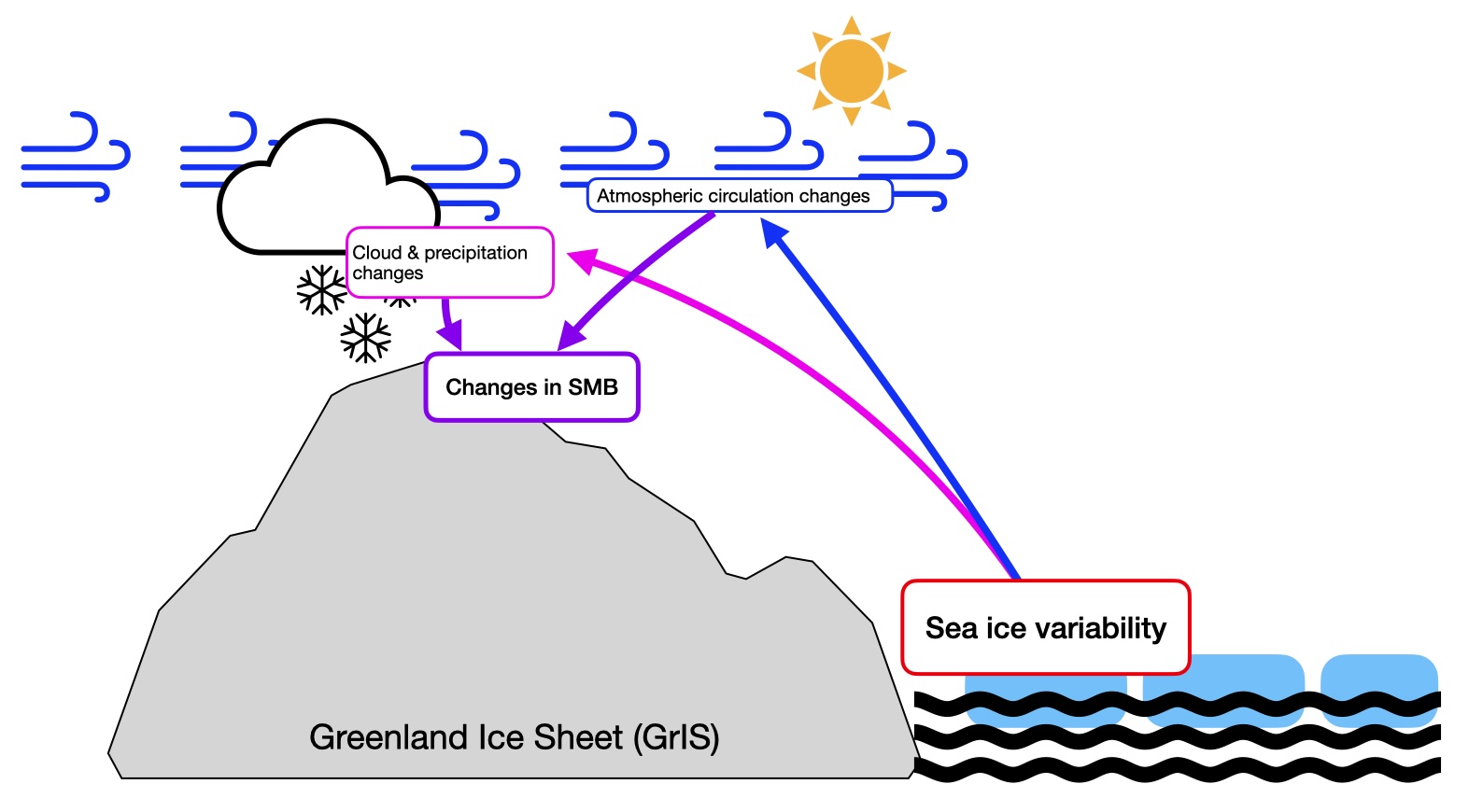
- I study how changes in Arctic sea ice affect the surface mass balance of the Greenland and Laurentide Ice Sheets, focusing on the competing roles of insulating sea ice, open-ocean heat fluxes, and atmospheric circulation.
- Using idealized experiments and simple energy-balance and diffusion models, I investigate how sea-ice–driven anomalies in surface fluxes and temperature propagate into the snow and firn and influence melt and refreezing.
These projects connect high-latitude processes to longer-term evolution of ice sheets and help clarify the physical pathways through which sea ice can modulate SMB.
Methods and Model Hierarchies
Across these projects, I use:
- Climate model simulations: for my paleoclimate research, I run CESM2 with CAM5 physics adjusting topography and bathymetry for LGM and 12ka conditions
- Climate model analysis: CESM2, iTraCE, CMIP6 control runs
- Simple and intermediate-complexity models: conceptual climate and ice-sheet models, stochastic ENSO models
- Numerical modeling: diffusion and energy-balance models for subsurface temperature and SMB
- Statistical tools: bootstrapping, surrogate time series, and machine-learning-based classification of westerly wind bursts
By moving up and down a hierarchy of models and data sources, I aim to bridge mechanistic understanding with realistic climate behavior.